Generative engine optimization services
By Jonathan DavidFounder, Discoverable
Updated
Generative engine optimization services, or GEO services, are professional services that help a business get named and cited when people ask ChatGPT and other AI assistants for a recommendation. The work happens on the business's own website and on the other websites AI assistants read, and it is measured by asking the assistants the same buying questions over time.
54% of UK adults say they use AI tools such as ChatGPT, up from 31% in 2024, Ofcom reported in June 2026. When one of them asks an assistant which business to use, the answer names a handful of businesses instead of listing ten links. If it names your rivals and not you, that customer may never reach your website. Generative engine optimization services are what agencies and freelancers sell to change that.
This guide is for business owners deciding whether to buy GEO services. It covers what they include, how the work is done, what they cost, how long they take and how to choose a provider, and every outside figure links its source.
Discoverable makes software that checks whether AI assistants name a business, and sells a GEO service of its own, described at the end of this page.
What do generative engine optimization services include?
Providers package the work in different ways and under different names, but most generative engine optimization services are built from the same parts. Expect a proposal to include some or all of these:
- An AI visibility audit. Someone asks AI assistants the questions your customers ask, and records which businesses each answer names, what it says about them and which websites it cites. Every later report is compared with this one.
- Question research. A list of the questions people in your market ask AI before they buy, written the way they would type them.
- Technical access. Checking that your website lets the crawlers AI companies use read your pages, in your robots.txt file and your hosting's bot settings, and that your key facts are in the text of the page rather than only in images.
- Content. Rewriting your main pages so each answers one question plainly near the top, and adding pages for questions your website does not answer yet, such as prices, comparisons and who you work with.
- Mentions on other websites. Getting your business onto the review sites, directories, comparison lists, forums and news sites that AI answers cite for your category.
- Reviews and listings. Keeping your Google Business Profile and directory listings complete and the same everywhere, and asking real customers for reviews.
- Structured data. Schema markup that states your business's details in a form machines read. Google says it is not required for its AI features, though it still helps with rich results.
- Reporting. Asking the same questions again on a schedule, and reporting how often each assistant names your business and cites your website compared with your rivals.
Before you sign, ask which of these parts the price covers. Fiverr's guide to GEO projects lists content at scale, website changes, link building, paid media and social as usually not included.
How do GEO services work?
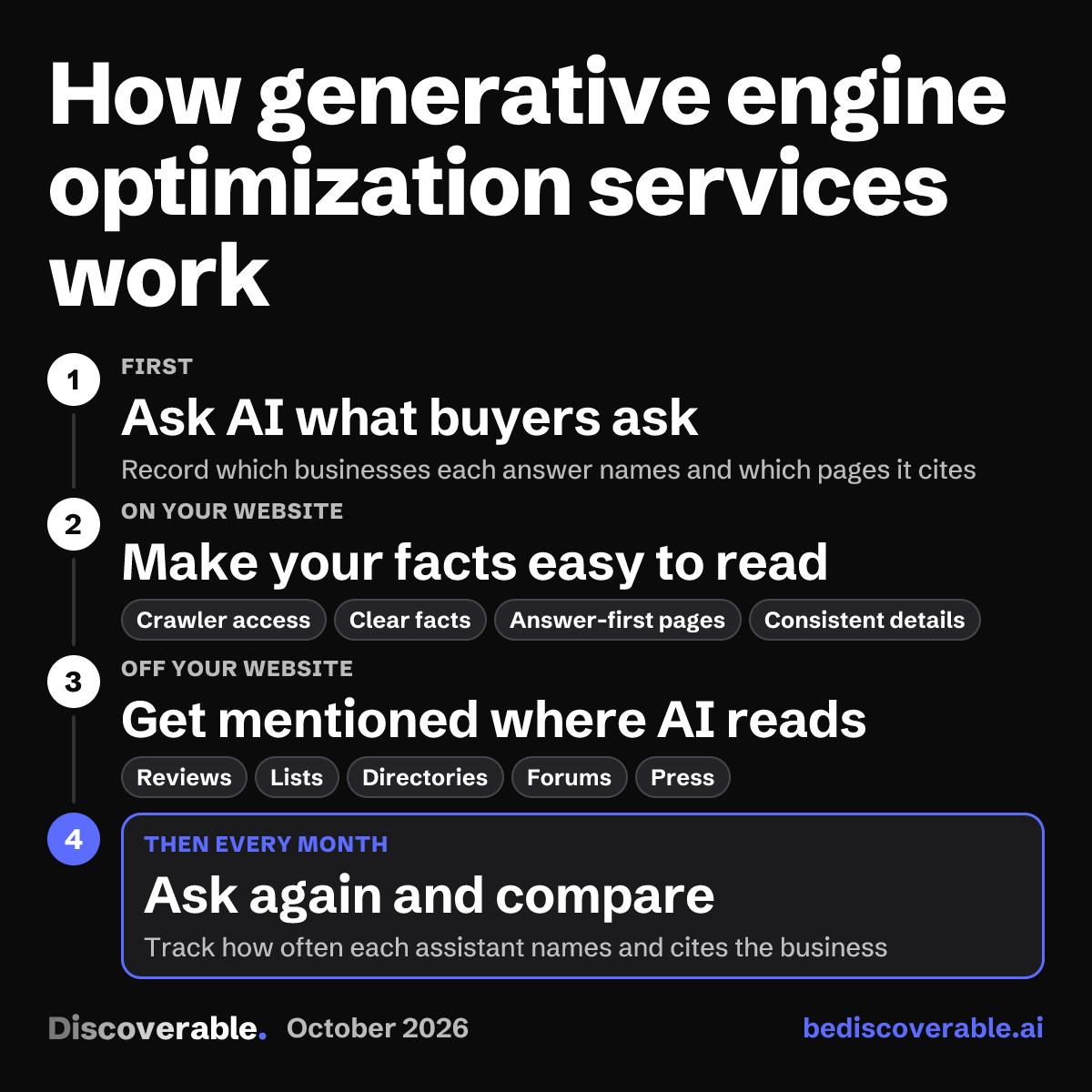
Whoever does it, the work follows the same loop, shown in the diagram at the top of this page.
- Ask AI what buyers ask. The provider puts your customers' questions to the AI assistants they use, without naming your business, and records which businesses each answer names and which pages it cites. A question that names you only shows what AI says to someone who already knows you.
- Make your facts easy to read. On your own website: access for AI crawlers, clear facts about what you sell, where and to whom, pages that answer a question in their first lines, and the same details everywhere your business appears.
- Get mentioned where AI reads. Off your website: reviews, the lists and directories in your category, the forums where your customers ask for advice, and the press. Assistants that search the web build their answers from pages like these, so a business those pages leave out is less likely to be named.
- Ask again and compare. The same questions, asked again every month, show whether more answers name your business and cite your pages. The trend across many answers is the result, because the same question gets different answers from one day to the next.
Do I need GEO services?
Check before you buy. Ask ChatGPT and one or two other assistants the questions your customers ask, without your business's name in them, and look at who is named. A free tool such as Discoverable's AI visibility checker does the asking for you.
GEO services are more likely to be worth paying for when:
- Your customers research before they buy, as they do for software, professional services, holidays and larger purchases.
- AI answers about your category name your rivals and not you.
- AI states something wrong about your business, such as old prices or a service you no longer offer.
- Your website is in good order but few other websites mention you.
They are less likely to be worth it when:
- Your customers buy on impulse, or already know whom to call.
- AI answers already name you for the questions that matter to you.
- Your website has basic problems, such as pages search engines cannot read. Fix those first: Google says its AI features are rooted in its core Search ranking systems.
- Your budget would buy only a few hours a month, which may do more if you spend them asking customers for reviews and fixing your own listings.
How much do GEO services cost?
There is no standard price. Providers sell very different amounts of work under the same name, from a one-off audit to a team writing and pitching every week. These are prices providers publish on their own pages, as read in October 2026:
- Marketplace freelancers. Gigs in Fiverr's generative engine optimization category started at between £12 and £2,091, and GEO offers on PeoplePerHour at £80 to £310. Fiverr's own guide on its page puts experienced specialists at $30 to $45 an hour.
- UK agencies, small-business packages. NeuralAdX from £450 a month plus VAT, for 5 tracked questions and one page improved a month; Footprint Digital from £1,250 a month; Buried £1,200 to £3,000 a month for a small business; MarGen £2,950 a month plus VAT, with a three-month minimum.
- Larger UK packages. Buried £3,000 to £8,000 a month for a medium-sized business and £8,000 or more for an enterprise; NeuralAdX up to £10,000 a month plus VAT; MarGen from £12,950 a month.
- Mentions only. Bubblegum Search sells outreach on its own at £550 to £1,800 a month plus VAT, for one to four mentions a month, and prices website work separately.
- One-off audits. MarGen charges £2,950 for an audit, credited against the first month, and Buried £2,000 to £12,000 for an audit and roadmap.
- US agencies. WebFX starts at $3,000 a month, KillerSEOx at $997 a month for a single location, and Omniscient Digital at $10,000 a month.
- A survey. In SE Ranking and Duda's survey of 260 agencies, published in December 2024, those that had priced AI Overview work charged about $937 a month on average.
- Software. AI visibility tracking tools check what assistants say about you and leave the work to you, for a monthly subscription. AI visibility tools for small businesses compares their prices.
What moves the price is how many websites, products or locations are covered, how many questions are tracked, how much writing and outreach is done each month, and whether paid listings or press fees are included. To compare quotes, ask each provider what it will deliver every month in numbers: pages written, pitches sent, listings submitted and questions tracked.
How long do GEO services take to work?
Providers' estimates are close to each other: first signs within one to two months, and a clearer change after three to six. They are the providers' own estimates; we found no independent study of how long paid GEO work takes.
- Fiverr's guide: early signals in 4 to 8 weeks, meaningful shifts in 2 to 4 months, and a sustained share of voice after 6 months or more.
- Buried: early shifts within 4 to 8 weeks, and a meaningful advantage over 3 to 6 months.
- MarGen: first new citations within 4 to 8 weeks, and measurable movement on your main questions within 90 days.
- Google, on search in general: some changes take effect in a few hours and others take several months, so wait a few weeks before judging whether a change worked.
Timings differ because answers come from two places. An assistant that searches the web as it answers can use a changed page soon after a search engine reads it again. What a model learned in training changes only when a new version comes out. Work on other websites, such as reviews and lists, moves at the pace of the people who run them.
How do I choose a GEO agency?
Google's advice on hiring an SEO applies to GEO services too. It says no one can guarantee a first place in Google, and to be wary of firms that email you out of the blue. Its guidance on third-party services adds that "Third-party tools don't have access to our internal ranking data".
Ask each provider these questions, and compare the answers:
- Which questions will you check? Ask to see the list of buyer questions the provider will put to AI, written the way your customers type them, and whether you can add your own.
- How will you measure results? How many times each question is asked, on which assistants and how often. One screenshot of one answer proves little, because the same question gets different answers.
- What will you do each month? Named work in numbers, such as pages written, pitches sent and listings submitted, and who does it.
- Does your advice match Google's? Google suggests asking whether a provider's GEO advice matches its official guidance on AI features, and giving a new provider read access to Search Console only at first.
- Who posts in my name? Whether anything is published, sent or posted in your name before you approve it, and whether forum posts say who they are from.
- What do I keep if I leave? The question list, the answers collected, the content written and your logins, and the notice period and minimum term.
- Can I see results for a client like me? Answers from before and after the work for a business of your size and type, rather than a headline percentage.
What a good GEO service will not do
- Buy or fake reviews
- Post anything without saying who it is from
- Publish anything in your name without your approval
- Promise that an AI assistant will name you
In the UK, fake reviews and reviews with hidden incentives are banned outright under the Digital Markets, Competition and Consumers Act 2024. Google's spam policies cover attempts to manipulate its AI answers, and Bing's guidelines say such attempts can lead to reduced visibility or removal.
What Google says about GEO
Google has published guidance on optimizing for its AI features, AI Overviews and AI Mode among them. It treats GEO as part of SEO: for Google Search, it says, optimizing for AI features is "still SEO".
The same guide lists things you can ignore for Google Search, some of which GEO services sell:
- llms.txt files. Google Search does not use them, though other services may.
- Breaking pages into chunks. Google says its systems understand pages that cover several topics.
- Rewriting pages just for AI. Its AI systems understand synonyms, so you do not need a page for every way a question can be asked.
- Inauthentic mentions. Seeking them out across the web "isn't as helpful as it might seem", in Google's words.
- Special schema markup. Structured data is not required for its AI features, though it still helps with rich results.
Google Search Console also has a generative AI control that decides whether your website can appear in AI Overviews and AI Mode at all. Websites are included unless an owner excludes them, so check yours is still included before paying anyone to improve it.
Does GEO work?
The research is mixed. The 2023 paper that named GEO found that adding citations, quotations and statistics to a page raised its visibility in AI answers by up to 40% in its tests, in which a model answered from five fixed search results. A 2025 benchmark that tested the same rewriting methods again found most of them ineffective, and often harmful to a page's ranking, while traditional SEO methods worked better.
A July 2026 review of 45 studies, not yet peer reviewed, found no technique with a proven, lasting effect across assistants. For a business owner, that means judging a provider by measured change in the answers about your own business, not by general claims.
GEO services vs SEO services
SEO services work to rank your website in search results. GEO services work to get your business named in the answer an AI assistant writes, which may cite your website or other websites that mention you. Much of the work overlaps, because assistants that search the web find pages through search engines.
| SEO services | GEO services | |
|---|---|---|
| Goal | Your website ranked in search results | Your business named in AI answers |
| What a buyer gets | A list of links to compare | One written answer naming a few businesses |
| Where the work happens | Mostly your own website, and links to it | Your website, and the reviews, lists, directories and forums AI reads |
| What is measured | Rankings, clicks and visits | How often answers name you, cite your pages and describe you correctly |
Can my SEO agency do GEO?
Often, yes. Ask whether it also does the work off your website, such as reviews, listings, lists and press, and whether it measures AI answers or only rankings.
GEO, AEO and AI SEO
The same work is sold as AEO services (answer engine optimization), AI SEO services and AI search optimization services, or by an AI visibility agency, and in British English as generative engine optimisation services. GEO comes from the 2023 research paper that coined the term.
Can I do GEO myself?
Much of it, yes. Google's advice on hiring an SEO says a small local business can "probably do much of the work yourself", and the same goes for GEO. These parts take time more than expertise:
- See where you stand. Ask the assistants your customers' questions in a private browser window, without your business's name, and note who is named.
- Let AI crawlers in. Check that your robots.txt file allows them. The AI crawler checker reads yours.
- Say the facts plainly. Put what you sell, where, to whom and at what price on your own pages, in words rather than images.
- Keep your listings complete. Fill in your Google Business Profile and the directories in your category, with the same name, address and phone number everywhere. Google says business profiles help businesses appear in its AI responses.
- Ask for reviews. Ask happy customers to review you on Google and on the review sites in your category.
- Get onto the lists. Find the "best" lists and directories AI cites for your category, and apply where they take submissions.
What is harder alone is measuring properly, since your own answers vary with your account, your location and the day, and outreach at volume. The guide to getting your business recommended by ChatGPT walks through each step.
How are GEO results measured?
Most providers report some of these measures:
- Mention rate: the share of answers to your tracked questions that name your business.
- Citation rate: the share of answers that link to or cite one of your pages.
- Share of voice: how often you are named compared with your rivals, across the same answers.
- Accuracy: whether what the answers say about your business is right.
One answer proves little either way. In SparkToro's January 2026 study, 600 volunteers ran the same questions 2,961 times, and ChatGPT and Google's AI gave the same list of brands in fewer than 1 in 100 pairs of answers. A sound measurement:
- Uses the questions buyers ask, without your business's name in them.
- Asks each question more than once, and counts how often you are named.
- Reads answers from the apps and AI search features people use. Answers from a developer's API can differ from the app's.
- Repeats the same questions every month, so each change is compared like for like.
Google adds a free check of its own: the generative AI performance report in Search Console counts how often links to your website appear in AI Overviews and AI Mode, by page, country and device.
Generative engine optimization in numbers
- ChatGPT: more than 1 billion weekly users, OpenAI said in August 2026.
- Google's AI features: AI Overviews have more than 2.5 billion users a month and AI Mode more than 1 billion, Google said in June 2026.
- In the UK: ChatGPT had 252 million UK visits in August 2025, up 156% on a year earlier, and is the second-largest search service after Google, Ofcom reported.
- Local recommendations: use of ChatGPT and other AI tools for local business recommendations rose from 6% to 45% in a year, in BrightLocal's 2026 survey of 1,002 US adults.
- Clicks: when Google showed an AI summary, people clicked a traditional search result in 8% of visits, against 15% when it did not, in Pew Research Center's study of 900 US adults' browsing.
- Being cited: pages cited in an AI Overview got 120% more organic clicks per impression than pages that were not, in Seer Interactive's April 2026 study.
- Search volume: Gartner forecast in February 2024 that traditional search engine volume would fall 25% by 2026. In June 2026, Google said its search queries had reached an all-time high.
Questions about generative engine optimization services
Are GEO services worth it?
They can be if your customers ask AI assistants before they buy and the answers name your rivals instead of you. Check that first, for free, by asking the assistants your customers' questions yourself. If the answers already name you, or your customers do not use AI to choose, your money may do more elsewhere.
Can a GEO service guarantee that AI will recommend my business?
No. Nobody can make an AI assistant name a business: each assistant decides what to say, and the same question gets different answers. Bing's guidelines say plainly that GEO "does not guarantee grounding or citations in AI experiences". A provider can show how often you are named today, and whether that changes after the work.
What is a GEO audit?
A GEO audit records what AI assistants say today when people ask about your category: which businesses they name, which websites they cite and what they say about you, with a list of fixes. It is the usual first step, and some providers sell it on its own.
Who offers generative engine optimization services?
SEO and digital PR agencies that have added GEO, specialist GEO agencies, freelancers on marketplaces, and software companies that pair a tracking tool with a service. Lists of the best GEO agencies are usually written by an agency that ranks itself first, so read them as adverts.
What is the difference between GEO, AEO and AI SEO?
Little in practice. All three describe getting a business named in AI answers, and providers use the names interchangeably. Google treats GEO and AEO as part of SEO.
Do I still need SEO?
Yes. Google says a page has to be indexed and eligible for a snippet in Google Search to appear in its AI features, and assistants that search the web find pages through search engines too.
Do GEO services work for local businesses?
Yes, and the job is smaller. For a question such as "a good plumber in Leeds", answers draw on map listings, reviews and local directories as well as websites, so a complete Google Business Profile, steady reviews and consistent listings do much of the work. Google says business profiles help businesses appear in its AI responses.
What are the risks of GEO?
Paying for activity that changes no answers, and tactics that break the rules of the websites you depend on: fake reviews, forum posts that hide who wrote them, and pages made in bulk for every variation of a question. Google's AI optimization guide says the last breaks its scaled content abuse policy when it is done to manipulate its AI answers.
How do I compare GEO agencies?
Compare what each will do every month and how each measures results, rather than headline claims. Ask every provider the questions under how to choose a GEO agency, and put the answers side by side.
Discoverable's GEO service
If you would rather hand the work over, Discoverable's team does the weekly work in your Discoverable plan for you, and a check every week shows whether AI assistants name your business.
Nothing is published or sent in your name until you approve it.
Setup in your first week
We set up Discoverable for your business: your website, what you sell and where, your competitors and the questions your customers ask AI.
Your Discoverable plan
A check every week on all seven AI services Discoverable measures: whether each names your business when customers ask, and who it names instead.
Your plan's tasks, done every week
The team works through the week's tasks in your plan, in the order the plan sets.
- We write the pages and answers your plan calls for, and you approve each one before it is published.
- We submit your business to the listings and directories AI cites for your category. A paid listing goes ahead only if you approve it and its fee.
- We pitch the websites and lists AI cites, in your name and with your approval.
- We draft replies where your customers ask questions online. Each says who it is from, and you approve it before it is posted.
- We chase corrections when AI states something wrong about your business, starting with the pages the wrong claim came from.
A report and a call every month
A short report on how AI answers about you have changed, the work done and next month's plan, and a call to go through it.
Priced on request.
As with other AI search optimization services, the price depends on the work: how many websites, products or locations you want covered, and how much content and outreach you want each month. The price includes your Discoverable plan.
Check if AI recommends your business.
Run a free check in under a minute. No card, no login to see your score.